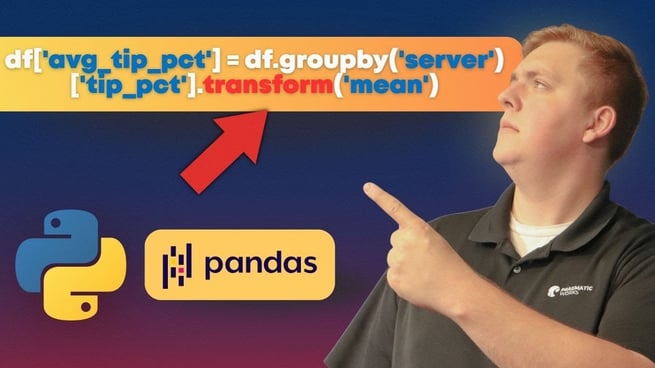
In this insightful tutorial, Zane Goodman from Pragmatic Works introduces the transform method in the Pandas library—a powerful tool for data aggregation that preserves the original structure of your DataFrame. This method is especially useful when working with grouped data where collapsing rows is not desirable.
Why Transform Matters
- Traditional aggregation methods like
groupby().sum() collapse rows into a single summary row per group.
transform allows you to apply aggregation functions while maintaining the original row structure.- This is ideal for scenarios where you want to retain detailed records but also include group-level metrics.
Real-World Example: Restaurant Tips
Zane walks through a practical example using restaurant data to analyze server performance based on tips:
- Data includes order ID, server name, order total, and tip amount.
- A new column
tip_percent is calculated as (tip / order_total) * 100.
- Average tip percentage per server is computed using
groupby and mean.
Common Pitfall: Merging Aggregated Data
Zane highlights the challenges of merging aggregated data back into the original DataFrame:
- Requires creating multiple DataFrames and performing a
merge operation.
- Risk of errors when merging on natural keys like server names due to inconsistencies (e.g., capitalization, spacing).
- Increased complexity and potential for bugs.
The Transform Solution
Using transform, Zane demonstrates a cleaner and more efficient approach:
- Group by
server.
- Apply
transform('mean') to the tip_percent column.
- Assign the result directly to a new column in the original DataFrame.
This method avoids the need for merging and ensures that each row retains its original context while displaying the group-level average.
Benefits of Using Transform
- Preserves row-level detail while adding aggregated insights.
- Reduces code complexity and improves readability.
- Minimizes risk of merge-related errors.
Final Thoughts
Zane emphasizes that while writing less code is often beneficial, clarity and readability should remain top priorities. The transform method strikes a balance between efficiency and maintainability, making it a valuable tool for any data analyst working with Pandas.
To dive deeper into Python and Pandas, Zane recommends checking out the Python for Data Analysis course on Pragmatic Works’ on-demand learning platform.
Have questions or want to explore more Pandas functions? Drop a comment on the video and Zane will be happy to help!
Don't forget to check out the Pragmatic Works' on-demand learning platform for more insightful content and training sessions on Python and other Microsoft applications. Be sure to subscribe to the Pragmatic Works YouTube channel to stay up-to-date on the latest tips and tricks.





.png?width=406&name=Custom%20Libraries%20in%20Databricks%20(1).png)


-1.png)
Leave a comment